Intro:
In the Abhidhamma, meditation is not viewed as a vague, relaxing feeling, but as a precise process of mental training. Mind is a rapid sequence of discrete consciousness moments (cittas) arising alongside specific mental factors (cetasikas).
Unfocused mind states are dominated by unwholesome factors like restlessness (uddhacca), dullness (thīna-middha), or sense desire (kāmacchanda). The goal of meditation is to systematically train the mind to produce streams of wholesome consciousness (kusala cittas) characterized by one-pointedness (ekaggatā), mindfulness (sati), and insight (paññā).
Access Concentration vs. Full Absorption
Absorption into the Jhānas is an advanced, highly specialized stage of mental culture (bhāvanā).
Normal Sense Mind (Kāmacchanda) ➔ Preparatory Samādhi (Parikamma) ➔ Access Concentration (Upacāra -Samādhi) ➔ Full Jhāna Absorption (Appanā-Samādhi)
Access Concentration (Upacāra-Samādhi)
At this level, the Five Hindrances (nīvaraṇas) are fully suppressed, and the five Jhāna factors (vitakka, vicāra, pīti, sukha, ekaggatā) are strong enough to keep the mind steady. However, consciousness still operates on the sense-sphere plane (kāmāvacara). The mind can still fall back into sense distractions if disturbed.
Full Absorption (Appanā-Samādhi)
Absorption occurs when consciousness completely transcends the sense-sphere and enters the Fine-Material Sphere (rūpāvacara). In this state:
The five physical sense doors (eye, ear, nose, tongue, body) completely shut down.
The mind experiences no physical sensations or sounds.
Consciousness becomes an unbroken, unified stream locked onto a single mental object for hours at a time.
Meditation:
1. The Abhidhamma Vision of Meditation
In the Abhidhamma, meditation is not viewed as a vague, relaxing feeling, but as a precise process of mental training. Mind is a rapid sequence of discrete consciousness moments (cittas) arising alongside specific mental factors (cetasikas).
Unfocused mind states are dominated by unwholesome factors like restlessness (uddhacca), dullness (thīna-middha), or sense desire (kāmacchanda). The goal of meditation is to systematically train the mind to produce streams of wholesome consciousness (kusala cittas) characterized by one-pointedness (ekaggatā), mindfulness (sati), and insight (paññā).
2. Access Concentration vs. Full Absorption (Appanā)
Absorption into the Jhānas is an advanced, highly specialized stage of mental culture (bhāvanā).
Normal Sense Mind (Kāmacchanda) ➔ Preparatory Samādhi (Parikamma) ➔ Access Concentration (Upacāra -Samādhi) ➔ Full Jhāna Absorption (Appanā-Samādhi)
Access Concentration (Upacāra-Samādhi)
At this level, the Five Hindrances (nīvaraṇas) are fully suppressed, and the five Jhāna factors (vitakka, vicāra, pīti, sukha, ekaggatā) are strong enough to keep the mind steady. However, consciousness still operates on the sense-sphere plane (kāmāvacara). The mind can still fall back into sense distractions if disturbed.
Full Absorption (Appanā-Samādhi)
Absorption occurs when consciousness completely transcends the sense-sphere and enters the Fine-Material Sphere (rūpāvacara). In this state:
The five physical sense doors (eye, ear, nose, tongue, body) completely shut down.
The mind experiences no physical sensations or sounds.
Consciousness becomes an unbroken, unified stream locked onto a single mental object for hours at a time.
3. The Mechanics: The Absorption Cognitive Process
To cross from sense-sphere consciousness into Fine-Material Jhāna, the mind must execute a precise mental sequence through the mind-door (manodvāra), known as the Appanā Citta Vīthi (Absorption Cognitive Process).
[Bhavanga] ➔ [BC] ➔ [BU] ➔ [MD] ➔ [Parikamma] ➔ [Upacāra] ➔ [Anuloma] ➔ [Gotrabhu] ➔ [Jhāna Citta] ➔ [Bhavanga...]
Bhavanga Calana & Upaccheda: The passive life-continuum stream vibrates and is cut off.
Manodvārāvajjana (Mind-Door Adverting): The active mind turns away from physical sense objects and directs itself toward the internal meditation sign (nimitta).
Parikamma (Preparation): Sense-sphere impulsion (javana) that prepares the mind for the transition.
Upacāra (Access): The mind approaches the boundary of the Fine-Material plane.
Anuloma (Conformity): The mind aligns itself with the higher frequency of Jhāna consciousness.
Gotrabhu (Change of Lineage): The critical moment where the mind "cuts the lineage" of sense-sphere consciousness (kāmāvacara) and establishes the lineage of fine-material consciousness (rūpāvacara).
Jhāna Citta (Absorption Consciousness): Immediately after Gotrabhu, the first Jhāna Citta arises, marking full absorption.
4. Mental Objects (Ārammaṇa) and Concepts (Paññatti)
To reach Jhāna, the mind must abandon physical, changing reality (paramattha dhamma) and lock onto an unchanging conceptual object (paññatti).
When you first begin meditating, you focus on a physical or actual reality—such as the touch of breath, the visual color of a disk (kasiṇa), or physical sensations. But physical objects are impermanent, fluctuating, and tied to the five sense doors.
To enter Fine-Material absorption, the mind abstracts the original object into a pure mental concept:
Preparatory Sign (Parikamma-nimitta): The initial, physical object of focus.
Acquired Sign (Uggaha-nimitta): The mental memory or replica of that object (seen with eyes closed), which still contains raw physical flaws and fluctuations.
Counterpart Sign / Countersign (Paṭibhāga-nimitta): A pure, luminous, flawless mental concept (paññatti) produced entirely by perception (saññā) when the hindrances are suppressed. The countersign is unmoving and completely detached from physical sense data.
When the mind-door process locks onto the paṭibhāga-nimitta, the transition to Jhāna occurs.
5. Meditation Subjects, Objects, and Jhāna Capabilities
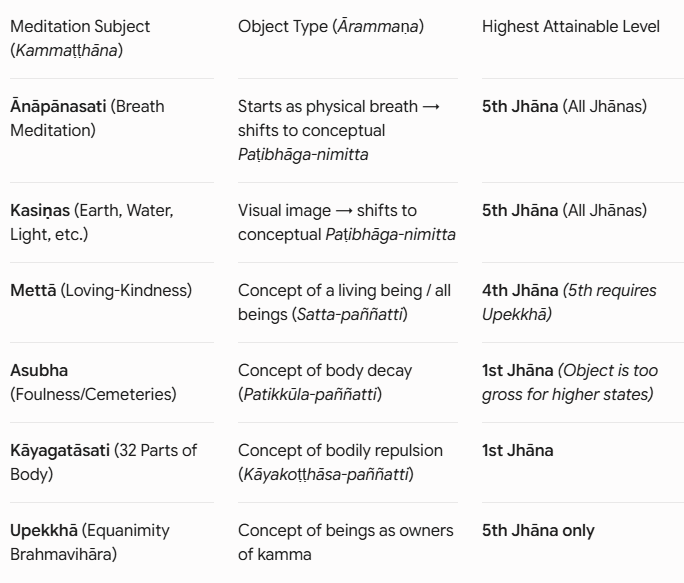
Different meditation subjects use different ultimate realities or concepts as their objects (ārammaṇa). Because objects vary in their subtle nature, not all meditation subjects can lead to all four (or five) Jhānas.
Below is a comparative breakdown according to the 5-fold Jhāna system of the Abhidhamma:
6. Abhidhamma Steps for Practice
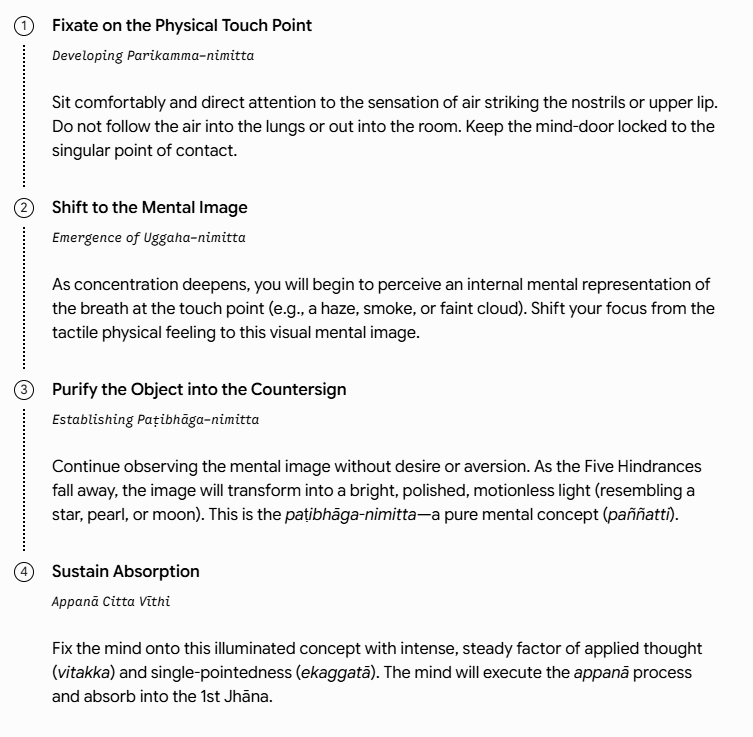
Practice A: Mindfulness of Breathing (Ānāpānasati)
Object: Concept of the refined breath (Paṭibhāga-nimitta).
Max Level: 5th Jhāna.
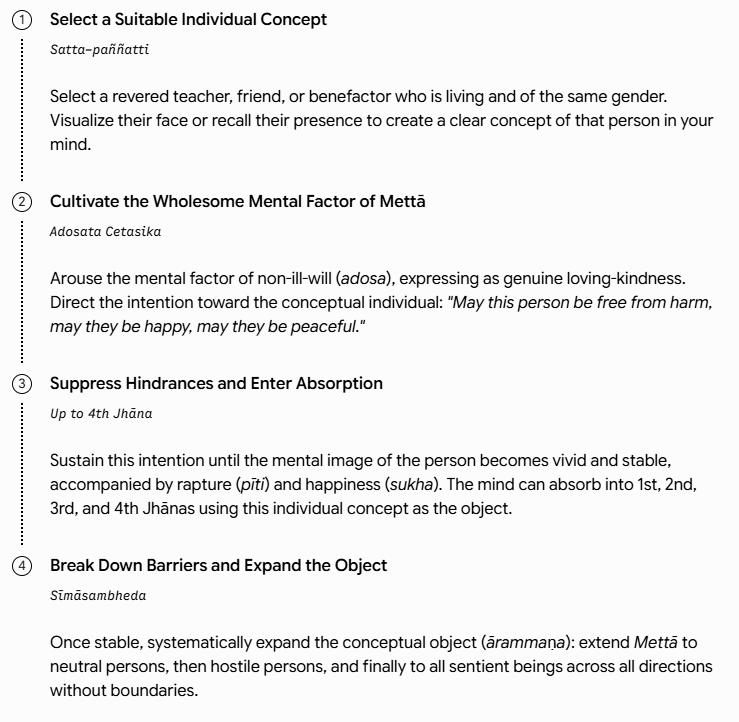
Practice B: Loving-Kindness Meditation (Mettā-Bhāvanā)
Object: The mental concept of a living being / beings (Satta-paññatti).
Max Level: 4th Jhāna (Abhidhamma 5-fold scheme).
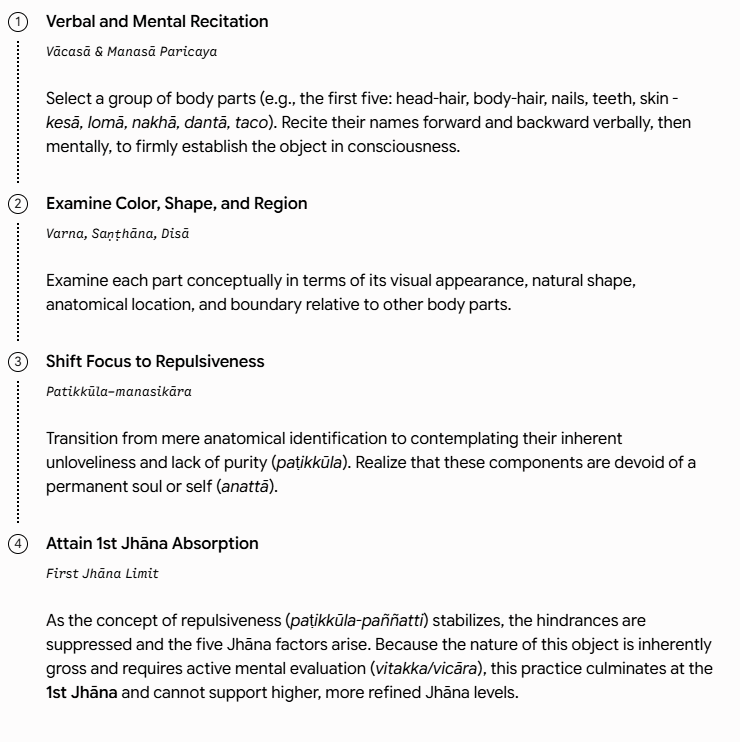
Practice C: Body Mindfulness (Kāyagatāsati / 32 Body Parts)
Object: Concept of the repulsive nature of physical organs (Patikkūla-paññatti).
Max Level: 1st Jhāna.